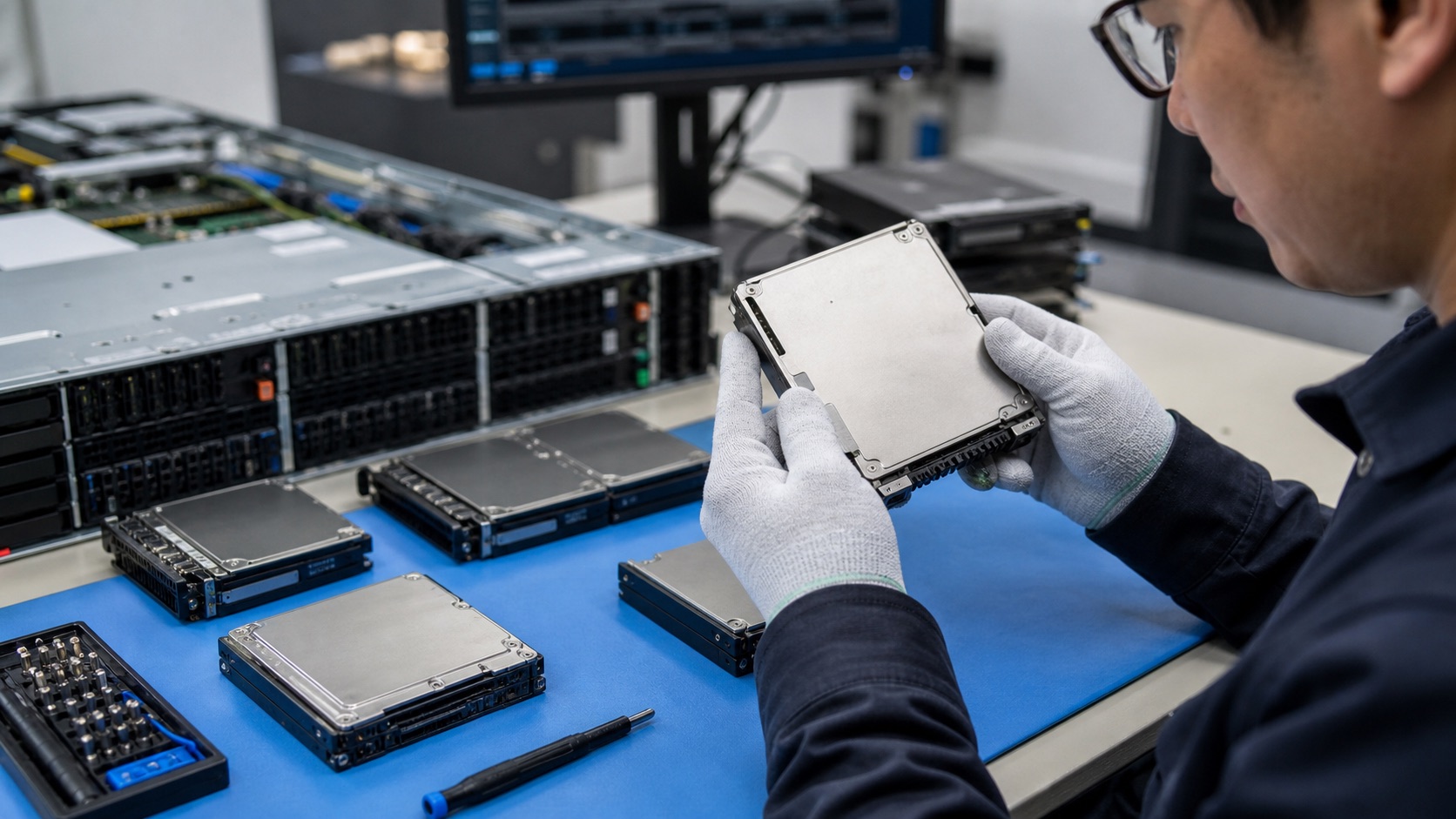
Enterprise SSD endurance should be matched to the actual write workload. Use DWPD or TBW together with capacity, warranty period, interface, form factor, power-loss protection and firmware qualification; do not buy by capacity alone.
Key takeaways
- Estimate host writes before selecting endurance class.
- Verify interface, form factor and firmware qualification.
- Treat used-drive health data as evidence, not a complete warranty.
Workload class affects usable life
Enterprise SSD endurance is commonly expressed through drive writes per day or total bytes written. A read-intensive drive can be a strong fit for content delivery or boot workloads, but not for sustained write-heavy databases.
Confirm interface and form factor
SATA, SAS and NVMe drives require the correct controller, backplane and firmware support. U.2, E3.S and 2.5-inch descriptions do not by themselves guarantee compatibility.
Ask for the exact model
A series name can contain several capacities, endurance classes and form factors. Request the complete manufacturer model or part number and check firmware requirements before purchase.
Translate the workload into measurable requirements
Start with service behavior rather than a product family name. Estimate average and peak reads and writes, block size, latency sensitivity, queue depth, retention period and expected annual growth. For SSDs, convert host writes into an endurance requirement and leave operational margin. For HDDs, identify whether the role is transactional, sequential capacity, backup, archive or RAID rebuild duty.
Document the consequence of failure and the maintenance model. A redundant array with stocked spares has a different procurement profile from a single boot device or a latency-sensitive database tier. Availability targets help determine whether dual-port access, power-loss protection, hot-swap support, firmware qualification or matched spares are required.
Verify the complete interface path
A form factor does not identify the protocol. A 2.5-inch device may use SATA, SAS or NVMe, while U.2, U.3 and newer enterprise formats depend on the correct backplane and cabling. Confirm controller model, supported protocol, connector, lane configuration, power envelope, hot-swap behavior and operating-system support.
Platform vendors may qualify specific drive firmware even when a generic drive has similar hardware specifications. In storage arrays, unsupported firmware can affect health reporting, LED behavior, error recovery and support eligibility. Record the original drive part number, firmware and carrier information before approving an alternative.
Compare endurance, media health and warranty correctly
For SSDs, read DWPD and TBW together with capacity and warranty duration. A larger drive may show a higher TBW without offering a higher normalized endurance class. Consider over-provisioning, write amplification, sustained performance after cache exhaustion and power-loss protection when the workload is more demanding than boot or read-mostly service.
For non-new SSDs and HDDs, request the health data appropriate to the device, but interpret it as one part of acceptance. Hours, bytes written, reallocated sectors, error logs and remaining-life indicators require context. A clean snapshot cannot prove future reliability, so condition disclosure, test method, warranty and serial traceability remain important.
Plan replacements around array behavior
Before replacing or adding a drive, confirm capacity, sector format, rotational speed where applicable, interface, firmware and array qualification. A 512e and 4Kn mismatch can prevent recognition. A nominally larger drive may still be rejected because of usable block count, firmware policy or carrier differences.
RAID rebuilds create sustained load and temporarily reduce redundancy. Check backups, current array health, rebuild priority and spare policy before work begins. Introduce one controlled change at a time, retain the removed drive until validation is complete and monitor predictive errors, latency and rebuild progress rather than relying only on a green status light.
Write procurement and acceptance criteria into the order
The RFQ should state exact model or part number, accepted alternatives, capacity, interface, form factor, endurance class, sector format, firmware constraints, condition, quantity and destination. Ask the supplier to separate confirmed specifications from assumptions and to identify whether carriers, adapters or cables are included.
On receipt, verify labels, seals, carriers and ESD packaging; reconcile serials and quantities; then collect baseline health information before production use. Acceptance should include platform detection, expected negotiated link, capacity, firmware, error-free functional testing and a workload-appropriate observation period. Preserve the evidence with the purchase record.
Frequently asked questions
What does 1 DWPD mean?
It means the rated capacity can be written once per day over the stated warranty period, subject to the vendor specification.
Is TBW comparable across capacities?
Only with context. Larger capacities often have higher TBW, so normalize against capacity and warranty.
Can a read-intensive SSD run a database?
It may function, but sustained writes can consume its endurance early. Model the workload first.
Verification sources
For a purchase decision, verify the current manufacturer datasheet and the target server or storage platform guide.