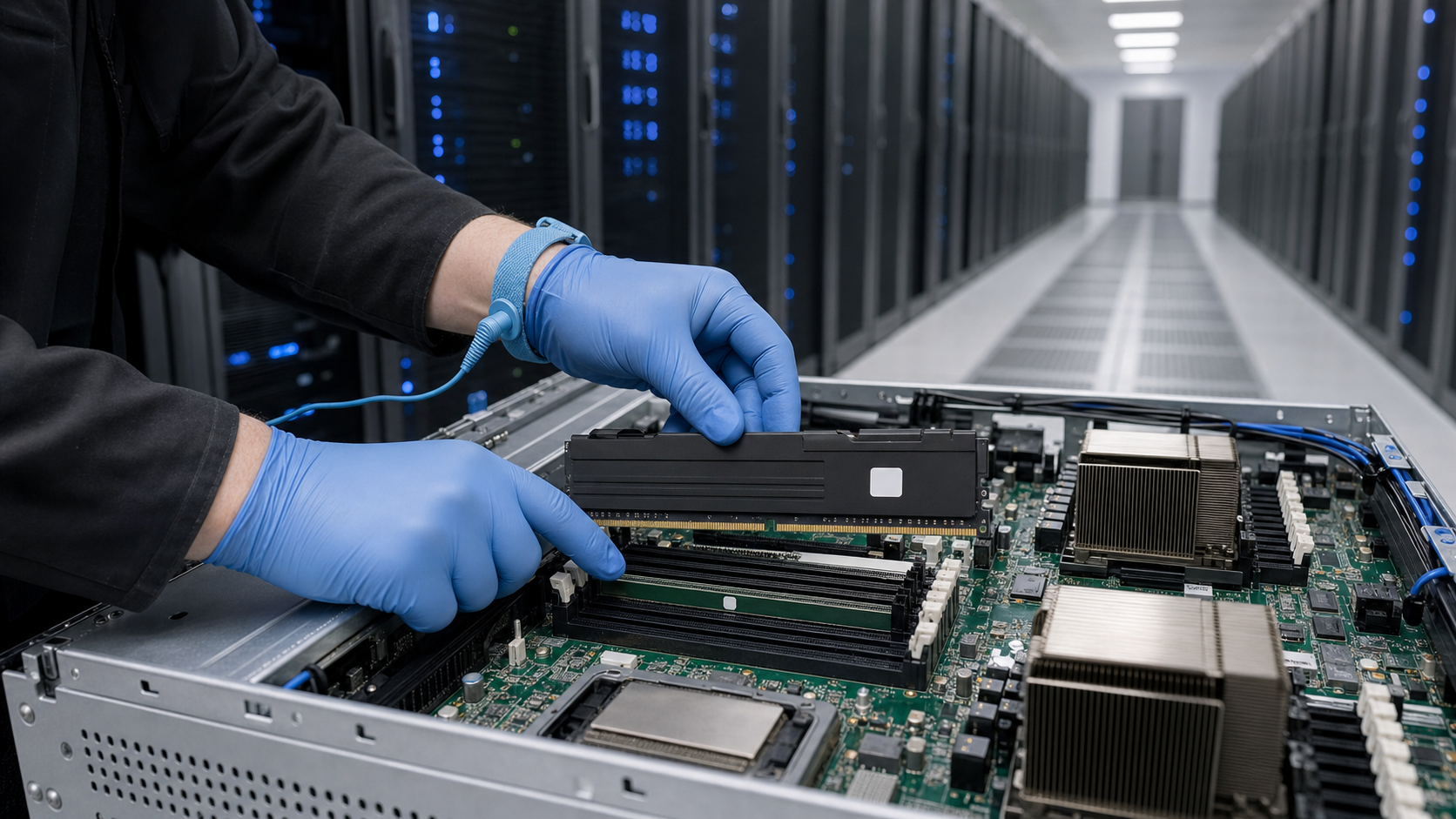
The choice between ECC RDIMM and LRDIMM for enterprise servers depends on capacity requirements, latency sensitivity, platform support, and budget. LRDIMM supports higher capacities and better signal integrity at full population but adds latency and costs more. RDIMM offers lower latency and lower cost but limited capacity scaling. Always verify compatibility with the server's QVL.
Key takeaways
- LRDIMM enables higher memory capacity per server but introduces additional latency.
- RDIMM is lower latency and lower cost but limited in capacity scaling.
- Compatibility with the server platform is critical; always check the QVL.
- For latency-sensitive workloads, RDIMM is often preferred; for capacity-intensive, LRDIMM.
- Power consumption and thermal impact differ; LRDIMM may require better cooling.
- DDR5 introduces new specifications; verify speed support per platform.
Introduction to RDIMM and LRDIMM
Registered DIMM (RDIMM) and Load-Reduced DIMM (LRDIMM) are two standard form factors for DDR4 and DDR5 server memory. Both use ECC (Error-Correcting Code) to detect and correct single-bit errors, but they differ in how they manage electrical load on the memory bus. RDIMM uses a register to buffer address and control signals, while LRDIMM adds a data buffer to reduce electrical loading further. This allows LRDIMM to support higher capacities per DIMM and more ranks per channel.
The primary advantage of LRDIMM is the ability to populate all memory slots with high-capacity modules without exceeding the memory controller's electrical limits. However, this comes at the cost of additional latency from the data buffer. Understanding these trade-offs is critical for server procurement, as the wrong choice can lead to performance degradation, instability, or incompatibility.
Capacity and Density Considerations
For servers requiring large memory footprints—such as virtualization hosts, in-memory databases, or HPC clusters—LRDIMM is often the preferred choice. LRDIMM modules can use 4R (quad-rank) or 8R (octal-rank) configurations, whereas RDIMM is typically limited to 2R (dual-rank) or 4R. For example, a 64 GB LRDIMM may use 4R while a 64 GB RDIMM uses 2R; the higher rank count reduces electrical loading per rank, allowing more modules per channel. In practice, a server with 24 DIMM slots using LRDIMM can achieve up to 3 TB of memory with 128 GB modules, whereas RDIMM might top out at 1.5 TB with 64 GB modules.
However, not all server platforms support LRDIMM. Some older or entry-level chipsets may lack the necessary memory controller features. Always verify the server's Qualified Vendor List (QVL) and memory configuration guide. For instance, Intel's Xeon Scalable platforms (e.g., Cascade Lake, Ice Lake) support both, but AMD EPYC platforms (e.g., Rome, Milan) have specific rank and speed limitations. Misconfiguring can result in system failure to boot or reduced memory speed.
Performance: Latency and Bandwidth
LRDIMM introduces additional latency due to the data buffer. In DDR4, typical LRDIMM latency is about one extra clock cycle per read operation compared to RDIMM. For memory-intensive workloads that are sensitive to latency, such as financial trading or real-time analytics, RDIMM may offer better performance. However, the difference is often small—on the order of 1-3% in real-world applications—and may be offset by the ability to use more memory channels or higher capacities.
Bandwidth-wise, both RDIMM and LRDIMM can achieve the same data rate (e.g., DDR4-3200 or DDR5-4800) if the platform supports it. However, LRDIMM's reduced electrical load allows the memory controller to run at higher speeds with more modules populated. For example, populating all slots with RDIMM at DDR4-2933 may force the memory speed down to DDR4-2400, while LRDIMM can maintain DDR4-2933. This speed advantage can compensate for the latency penalty in bandwidth-bound workloads.
Power Consumption and Thermal Impact
LRDIMM typically consumes more power than RDIMM due to the additional data buffer. For a 64 GB module, the difference is about 1-2 watts per DIMM. In a fully populated server with 24 DIMMs, this can add 24-48 watts of system power draw. While this may seem modest, it can affect thermal management in dense server configurations. Some LRDIMM modules also run hotter, requiring adequate airflow.
On the other hand, LRDIMM's ability to use fewer modules to achieve the same capacity (e.g., using 8x 128 GB LRDIMM instead of 16x 64 GB RDIMM) can reduce overall power consumption. The trade-off depends on the specific configuration. Always check the module's datasheet for operating voltage and thermal specifications. For DDR5, both RDIMM and LRDIMM use on-die ECC and voltage regulators, which may alter power profiles.
Compatibility and Platform Dependencies
Compatibility is the most critical risk when selecting between RDIMM and LRDIMM. Mixing RDIMM and LRDIMM on the same motherboard is not supported; all modules must be of the same type. Additionally, some server platforms only support one type. For example, Intel's Xeon E-2300 series (entry-level) supports only RDIMM, while Xeon Gold 6400 series supports both but may require specific BIOS settings.
Memory speed is also platform-dependent. For DDR5, the JEDEC standard defines separate specifications for RDIMM and LRDIMM, and the maximum supported speed may differ. For instance, a server may support DDR5-4800 RDIMM but only DDR5-4400 LRDIMM. Always consult the server's technical manual or memory configuration tool. Using unsupported memory can cause boot failures, system instability, or void warranty.
Cost and Availability
LRDIMM modules are generally more expensive than equivalent-capacity RDIMM modules due to the additional buffer components and higher manufacturing complexity. The price premium can range from 10% to 30% depending on capacity and speed. However, if LRDIMM allows using fewer modules to achieve the required capacity, the total system cost may be lower.
Availability can also be a factor. High-capacity LRDIMM modules (e.g., 256 GB DDR4) are less common and may have longer lead times. For enterprise procurement, it is advisable to source from reputable distributors and verify that the modules are on the server's QVL. Counterfeit or mismatched modules can cause data corruption or system crashes.
Use-Case Recommendations
For workloads that require maximum memory capacity per server, such as large virtualized environments or in-memory databases (e.g., SAP HANA), LRDIMM is the recommended choice. It allows scaling to terabytes without sacrificing speed. For latency-sensitive applications like high-frequency trading or real-time signal processing, RDIMM may be preferable if capacity requirements are moderate.
For general-purpose enterprise servers with balanced workloads, either type can work, but the decision should be based on the specific server model and memory configuration. It is also worth considering future upgrade paths: LRDIMM may offer better headroom for capacity expansion, while RDIMM may be more cost-effective for initial builds. Always test the chosen configuration in a lab environment before full deployment.
Conclusion
Selecting between ECC RDIMM and LRDIMM requires careful evaluation of capacity needs, performance sensitivity, platform support, power constraints, and budget. There is no universal best choice; the correct answer depends on the specific server hardware and workload. Always verify compatibility with the server manufacturer's documentation and consider consulting with a memory specialist for large-scale deployments.
By understanding the risks and trade-offs outlined in this guide, procurement teams can make informed decisions that avoid costly mistakes. Remember that memory configuration is a critical factor in server reliability and performance, and cutting corners can lead to significant operational issues.
Frequently asked questions
Can I mix RDIMM and LRDIMM in the same server?
No, mixing RDIMM and LRDIMM is not supported. All modules must be of the same type. Check the server manual for supported configurations.
Which is better for virtualization: RDIMM or LRDIMM?
For virtualization, where high memory capacity is often needed, LRDIMM is generally preferred because it allows larger memory footprints. However, if latency is critical, RDIMM may be better.
Does LRDIMM work with all server platforms?
No, LRDIMM requires platform support. Some older or entry-level chipsets do not support LRDIMM. Always verify with the server's QVL.
Verification sources
For a purchase decision, verify the current manufacturer datasheet and the target server or storage platform guide.